Christian Triumph?


In Rome a triumph was a” spectacular victory celebration parade” for a military commander who had won an important victory on the battlefield(Cartwright).  A triumph was granted by the Senate and was a lavish and entertaining propaganda spectacle which was meant to reminded Romans of their glory and their military superiority above all other nations. It usually included the romans building and arch like this:

Did Christianity deserve a triumph? Did Christian beliefs have victory over the allegedly false beliefs and practices of paganism? Yes. Christianity desrved a triumph because it become the obvious authority figure in the region, its power through the church lead nearly all to believe it had the power to grant and bar people access to heaven, even when others succeeded in killing a christian they only succeeded in creating another martyr, Christianity became the only accepted religion in the empire and it still exists today.

Those who were in power were those who decided whether or not a triumph was due, and Christianity was in power. “According to the 5th-century CE historian Orosius, there were 320 triumphs in Rome up to the 1st century CE” (Cartwright). Apparently, a triumph was not entirely uncommon, and the Church was definitely the power in charge at the time, and they held this power principly through their ability to cut someone off from heaven itself. Even the head of state, the Emperor, at one point received the blessing of the head of religion, the pope, to reign, inferring that “the act of crowning the emperor show the pope’s superior authority as the giver of the empire to King Charles” (Graves).
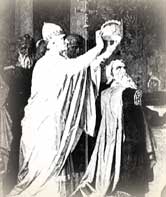
Charlemagne Crowned as Holy Roman Emperor

Furthermore, the church was involved in so many aspects of a person’s life, from birth to death and it made itself a necessity for every stage in order to make it to heaven. History hit, a popular website that uncovers powerful insights about the past makes this statement about how it was that the church was able to put itself into so many facets of the lives of everyday people, “the power of the Church lay in their perceived status as the gatekeepers to heaven. Cross them in any way, shape or form and you could find yourself barred from the gates of paradise.”(How the Church Dominated Life in the Middle Ages). With this in mind, let me bring to light that in the middle ages every peasant had to give up a portion of their weekly work to labour on church land for free, on top of the 10% tithe that was expected in order to make it into heaven. Because most people were subsistence farmers at the time, this was a large burden, but one that nearly everybody worked tirelessly to fulfill for fear of not getting into heaven.

Furthermore, the rich, who did not have the same economic burden were under the thumb of the church as well. Even the wealthy, and many monarchs could never be as rich as the Church. The church gathered wealth in many ways included charging people for baptism. If one was not baptized, then one could not be buried in the graveyard of the Church and therefore the gates of heaven would be closed off to them. The church also allowed for people to pay it in order to absolve themselves from sins, those which have already been committed, and “even those not yet committed”. With this large accumulation of wealth the “Church did not have to pay taxes” which furthered its economic power (How the Church Dominated Life in the Middle Ages). On top of all of this the Church could promise heaven to people in exchange for fighting in one of its crusades, which mobilized many thousands of men including those who were wealthy.

Image result for catholic graveyard next to church
What a church graveyard could have looked like

Every effort that Rome made to thwart Christianity, especially through killings, lead to only greater vigor of the saints. Even after the death of Christ himself many “were motivated to mission or to spread the ‘good news’ (‘gospel’) that the kingdom of God would arrive soon”(Denova). “The Greek word martus signifies a witness who testifies to a fact of which he has knowledge from personal observation”(Knight). It is in this sense that the term first appears in Christian literature; the Apostles were “witnesses” of all that they had observed in the public life of Christ, as well as of all they had learned from His teaching, “in Jerusalem, and in all Judea, and Samaria, and even to the uttermost part of the earth” (Acts 1:8). Many Christians even “desired” to be “honored with martyrdom” (Knight). So we can see that the romans, as far as the Christians were concerned were simply creating another witness with every murder that they committed.

Christianity deserves a triumph because they eventually became the only accepted religion of the state in a place where for hundreds of years the Romans had made deliberate decisions to not coerce it’s people, or it’s subservients on ideas of religion. This began with Constantine winning a battle against Maxentius which helped him secure power. Constantine later told the story “that the night before the battle (at the Milvian Bridge in Rome), he saw a sign in the sky (either chi and rho, the first two letters of Christ, or a cross) and heard a voice that commanded “in hoc signo vinces” (“in this sign conquer”). Constantine claimed that he won the battle with the support of the Christian god.” (Denova). Under the rule of Constantine living Christianity become more beneficial and singular. Eventually In “381 CE, Theodosius I issued an edict that banned all cults except Christianity. In the 390’s CE he ordered the cessation of the Olympic Games, dedicated to the ancient gods, and the closure of pagan shrines and temples. Some of these buildings were destroyed, but others were transformed into Christian churches.” (Denova) This boxing out of all other religions lead Christianity to be the only religion accepted and was essentially a conquering of all other religions. This level of dominance deserves a triumph.

Christianity changed the way that the western world viewed religion. “In Greco-Roman culture people claimed ethnic identity from ancestors; you were literally born into your customs and beliefs. Conversion (moving from one religious worldview to another) was not common as your religion was in the blood.  Christianity taught that ancestry and bloodlines were no longer relevant. According to Paul, faith (pistis, ‘loyalty’) in Christ was all that was needed for salvation.” (Denova) This allowed Christianity to do things that no other religion before could really do. Christianity could grow past geographic and ethnic borders, and it could reach more people than ever possible before. Changing this perception of what one’s religious constraints were was a huge victory for Christianity, adding to it’s justification for a triumph.

Christianity still exists today, whereas not even Rome persists in it originality. Not only did Christianity outlive Rome it out grew every other religion in the world with over 2.3 billion humans subscribing to Christianity today (Hackett et al.). Even now we have this symbol which reminds all who see it of christ: The ideologies and structure of christianity has endured through the ages.

Christianity has proven itself to be powerful, persuasive, almost ever present, enduring, and accepted to not only the poor, but the rich, not only the weak, but the most powerful rulers of the world, not only the rural, but the urban, all throughout history, I am confident that Christianity would have thrown itself a triumph had it desired to do so.

Works Citied

Cartwright, Mark. “Roman Triumph.” Ancient History Encyclopedia, Ancient History Encyclopedia, 27 Mar. 2019, http://www.ancient.eu/Roman_Triumph/.

Denova, Rebecca. “Early Christianity.” Ancient History Encyclopedia, Ancient History Encyclopedia, 27 Mar. 2019, http://www.ancient.eu/article/1205/early-christianity/.

Knight, Kevin. “Martyr.” CATHOLIC ENCYCLOPEDIA: Martyr, http://www.newadvent.org/cathen/09736b.htm.

Hackett, Conrad, et al. “World’s Largest Religion by Population Is Still Christianity.” Pew Research Center, Pew Research Center, 5 Apr. 2017, http://www.pewresearch.org/fact-tank/2017/04/05/christians-remain-worlds-largest-religious-group-but-they-are-declining-in-europe/.

The Church and the Middle Ages, http://www.csis.pace.edu/grendel/projs2c/middle.html?cmd=redirect&arubalp=12345.

Graves, Dan. “Charlemagne Crowned as Holy Roman Emperor.” Christianity.com, Salem Web Network, 28 Apr. 2010, http://www.christianity.com/church/church-history/timeline/601-900/charl emagne-crowned-as-holy-roman-emperor-11629758.html.

“How the Church Dominated Life in the Middle Ages.” History Hit, http://www.historyhit.com/how-the-church-dominated-life-in-the-middle-ages/.

Knight, Kevin. “Martyrs of Palestine.” CHURCH FATHERS: Martyrs of Palestine, http://www.newadvent.org/fathers/2505.htm. Notes on Nicene and Post-Nicene Fathers, Second Series, Vol. 1
Suicide Writing Assignment

Suicide was not uncommon even in ancient Greece and it is not uncommon today. The reason behind why people commit suicide is difficult to know for sure, but we can tell through writings and research that glory, honor, and mental health have played varying degrees of importance over the years.

The choice that Achilles famously makes in The Iliad reveals the societal pressure for glory that is behind suicidal behaviors during Ancient Greece. Achilles explains to Odysseus his predicament, “My mother Thetis, a moving silver grace, Tells me two fates sweep me on to my death. If I stay here and fight, I will never return home, But my glory will be undying forever. If I return home to my dear fatherland My glory is lost but my life will be long, And death that ends all will not catch me soon”(Homer 98). This quote shows better than any other by Homer the importance of glory during this time period. Achilles decision was a famous one, but the choice between an obscure life and a glorified death was a common one at the time. It seemed that glory was most easily and commonly won on the battleground. The allure of glory forever was thought to be worth death, even throwing yourself at death knowingly as Achilles chooses to do. There is some validity to this, however, the reason that our society is still talking about Achilles today is likely because of this decision he made to give up his life, in order to receive glory. Had he gone home, would he be such a household name?

We do know that even though this appears to be an advantageous decision in the long run for Achilles, it is not a decision he would have made again. In The Odyssey, while Odysseus is visiting the underworld Achilles tells his fellow comrade, “Don’t try to sell me on death, Odysseus, I’d rather be a hired hand back up on earth, Slaving away for some poor dirt farmer, Than lord it over all these withered dead. But tell me about that boy of mine. Did he come to the war and take his place As one of the best? Or did he stay away?” (Homer 346). Achilles obviously decides after the fact that he would rather have lived a long life, even if it meant living as one of the absolute lowest rank in society. He feels that his glory does him no good after death, which is in stark contrast to the common beliefs at the time. Achilles, personally, does not think that it was worth trading glory for an early death, but that does not mean that it is not important to him. We can see that he still asks after the status of multiple family members right afterwards, seemingly placing a large value on the glory that he hoped for them—the same glory that he said moments earlier was not worth trading life for.

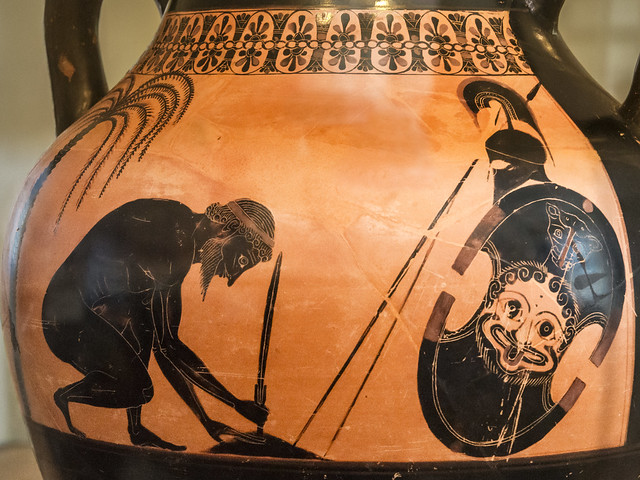
Comparatively, the reasoning behind why, and what was a socially acceptable reason to commit suicide have varied over these vast expanses of time and across regions. It appears that it is acceptable to take one’s own life for two reasons during the period of ancient Greece: in an effort to achieve maximum glory(as seen in the story of Achilles), but also to hide from a severe loss of honor as we see in story of Ajax when he lost a contest to Odysseus for the armor of Achilles. Odysseus says, “I wish I had never won. That contest buried Ajax, that brave heart, The best of the Danaans in looks and deeds,” (Homer 348). This loss of honor lead to Ajax hallucinating and killing sheep and eventually killing himself. This loss of contest is important to take with context. Ajax was said to be second in strength and skill in fighting only to Achilles. Again, fighting was the principle manner through which one gained glory. Losing to Odysseus, who was a good fighter, but not near the level of Ajax was something that was just too hard for him to bear. Ajax says himself, “And as for my shield and the rest of my armour, let them not be the object of some contest or other and let no one be the judge as to who’ll be its new owner, especially not, Odysseus, the man who’s destroyed me.”It appears that for Ajax, death was a much better option than the loss of honor that would follow a defeat like the one he experienced. Ajax may have even felt that he may retain some of his honor though this suicide, and he definitely blames the loss of this competition for his downfall.

Aithiopis X – Ajax Suicide by Exekias

Ultimately,Ajax committed suicide for a specific reason, and it seems to be the same reason that it is such an epidemic today in America, that is mental health. This is clear as he is slaughtering pigs that he thinks are men, even Athena says that “he was driving himself deep into his madness (Sophocles’). Mental health problems are correlated with suicide here in the United States quite strongly. Mental Health America has stated that, “most people who die by suicide have a mental or emotional disorder.” (“suicide”). The increase in mental health problems in the United States is concerning. It was probably present in ancient times surrounding suicide as when Jocasta exhibited mad behavior when she “with both hands tore her hair,” form her head (Sophocles lines 1295). Mental illness seems to be sweeping the nation in modern times. This mental health and its correlation with suicide deaths reflects what seems to be a lack of real social interaction in our society. Psychology Todayran a study where, “participants were more likely to feel depressed when they spent time comparing themselves to others on social media.”(“How to Avoid Depression Induced by Social Media.”). The correlation between mental health could very wellbe because of the rise of social media and how it limits our quality interaction with other people.

Meanwhile, in the past 20 years Utah has seen “46.5 percent increase in residents taking their own lives” (Nutt. Salt lake Tribune) and the reasons behind taking one’s own life in modern times seems to be largely because of “depression” (The Six Reasons People Attempt Suicide). That is oversimplifying the reason though. There are strong similarities between why people commit suicide now compared to ancient times. One researcher said, “Americansstand out from people in other countries with respect to their focus on individualism. Americans believe that success is determined by our own control and that it is very important to work hard to get ahead in life. Perhaps it is this focus on our own achievements, successes, and work culture that have created an environment that is no longer sustainable—it has become too stressful.” (Swahn). Ajax committed suicide for these same reasons. Because there was so much pressure on Ajax to be the best, due to his fighting prowess and his strength, anything other than perfection was outside of the realm of acceptability to him. Likewise, many Americans feel that they are so privileged due to their living in the most prosperous nation on earth in many ways, that they too feel that anything other than self-made ultra-success is unacceptable. Both of these emotions can lead to the taking of one’s life, whether it be in ancient times or modern.

Notably, suicide has always been a problem, and in ancient Greece, it seemed that achieving glory, and preserving one’s honor were the leading causes. These two reasons reflect the values of the times, especially the conquering nature of the countries back then and the value placed on dominating others, even at the expense on one’s own life. In modern times and in ancient times, great sadness can lead to suicide, revealing the importance of other people in our lives. Throughout history people have felt reason that they could not or should not exist, and it has always left those telling the story with heartache.

Works Cited

Homer. Essential Homer, Hackett Publishing Company, Inc., 2000. ProQuest Ebook Central, http://ebookcentral.proquest.com/lib/byu/detail.action?docID=473607.

“Suicide.” Mental Health America, 22 Oct. 2018, http://www.mentalhealthamerica.net /suicide.

“Sophocles’.” Poetry in Translation, www.poetryintranslation.com/PITBR/Greek/Ajax.php.

Sophocles. Oedipus the King, Hackett Publishing Company, Inc., 2001. ProQuest Ebook Central, http://ebookcentral.proquest.com/lib/byu/detail.action?docID= 473607.

“How to Avoid Depression Induced by Social Media.” Psychology Today, Sussex Publishers, http://www.psychologytoday.com/us/blog/evidence-based-living/201701/how-avoid-depression-induced-social-media.

Nutt, Amy Ellis, and Washington Post. “Utah’s Suicide Rate Has Shot up 46.5% since 1999 – Making It the Fifth-Highest in the Nation.” The Salt Lake Tribune, http://www.sltrib.com/news/2018/06/07/suicide-rates-rise-sharply-in-utah-and-across-the-country-new-report-shows/.

“The Six Reasons People Attempt Suicide.” Psychology Today, Sussex Publishers,www.psychologytoday.com/us/blog/happiness-in-world/201004/the-six-reasons-people-attempt-suicide.

Swahn, Monica H., and Monica H. Swahn. “Why Are Americans so Sad?” Quartz, Quartz, 14 June 2018, qz.com/1306176/why-are-americans-so-sad/.

Epithets

  • Seeker of Thrills

I really enjoy personal electric transportation advices. I have won a few from work, invested in a couple on my own. One day I hope to drive a Tesla around town. My favorite one is my electric longboard, there just isn’t anything like unlimited carving, but the most interesting one is my electric unicycle- enough said.

  • Reader of Books

I love to read books. I read 80 books with an average of over 300 pages per book in 2016. I have started to read a little less than that as I have picked up podcasts and started reading the news but still read over 60 books a year. I am on Goodreads, which is a platform to archive and review books that you have read. It’s a liiiitle bit like facebook for nerds. I always look at what my friends, as well as all of Goodreads, have reviewed a book (1-5 stars) before starting it. p.s. I listen to most books on audible.

  • Voracious Voyager

I am always looking for new places to go and see. If it’s a three day weekend, you can count on me road tripping. In fact, my spouse and I took this last semester off to go and travel to 31 different countries across Europe and South East Asia. I can’t say enough good things about this experience. I loved being somewhere new all the time. For those interested, my favorite country was Vietnam, with Scotland, Switzerland, and Portugal coming in close succession to those. Interestingly, it was the one on one time with my wife, Annie that I remember the most fondly.

  • Maker of Deals

I have been doing summer sales for the past three years and I have loved it. I love making win-win scenarios with people. This expands into my passion for real estate. I recently bought my first investment property, and I have loved making the lives of my tenants better and also having my money make money rather than trade my time for money.

Design a site like this with WordPress.com
Get started